
Innovation Gallery
In freely accessible temporary exhibitions, leading Delft knowledge institutions and companies share their innovative knowledge and ideas.


The Innovation Gallery is an exhibition space where leading Delft knowledge institutions and companies share their innovative knowledge and ideas. During free temporary exhibitions, visitors discover how current Delft innovations respond to the major social issues of today and tomorrow. From biotechnology to crafts and from water to health.
This is an initiative of Deltares, dsm-firmenich, the Delfland Water Board, the IHE Delft the Institute for Water Education, the Reinier de Graaf Group, Royal Delft, TNO and TU Delft, in collaboration with the Huis van Delft and Delft Marketing.The Innovation Gallery is temporarily closed. We are currently setting up the following impressive exhibition: Robo Creatures Petting Zoo.
Robo Creatures Petting Zoo
During the autumn half-term, the Innovation Gallery will undergo another transformation. ‘Like Insects’ will make way for the ‘Robo Creatures Petting Zoo’, which will then be open to visitors until 2 November.
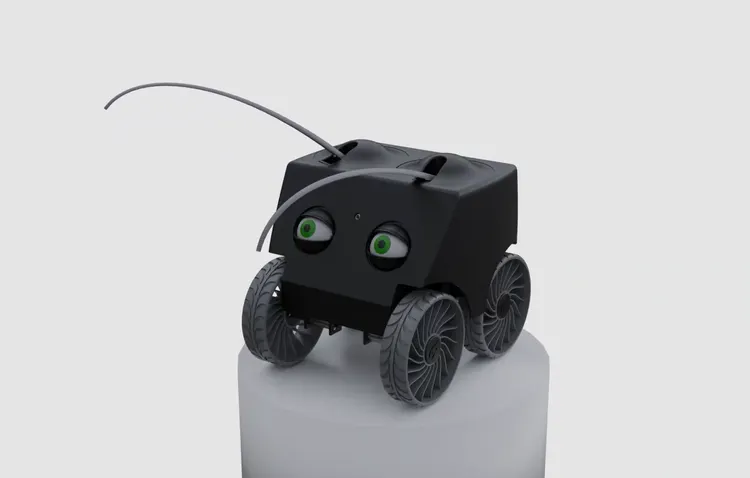
The Petting Zoo brings visitors closer to a completely different form of interactive technology: robots that behave like curious, playful or sometimes somewhat reserved creatures. Some can be touched, others react to movement or presence, whilst others are best observed closely.
The original Robo Creatures Petting Zoo was developed by students and researchers at TU Delft and previously showcased at Highlight Delft. The creatures include FLIP, which can see, hear and perceive people and reacts through movement and expressive eyes; Fizzy, a robotic ball that reacts to movement; and RoBotanics, in which mobile plants use sensors to react to the presence of visitors.
The Petting Zoo expressly invites visitors not just to watch robotics, but to play with it, interact with it and experiment with it.
Previously on display in the Innovation Gallery:
Like Insects – when fashion learns to respond
What happens when fashion is not only designed to be looked at, but can also perceive, move and react?
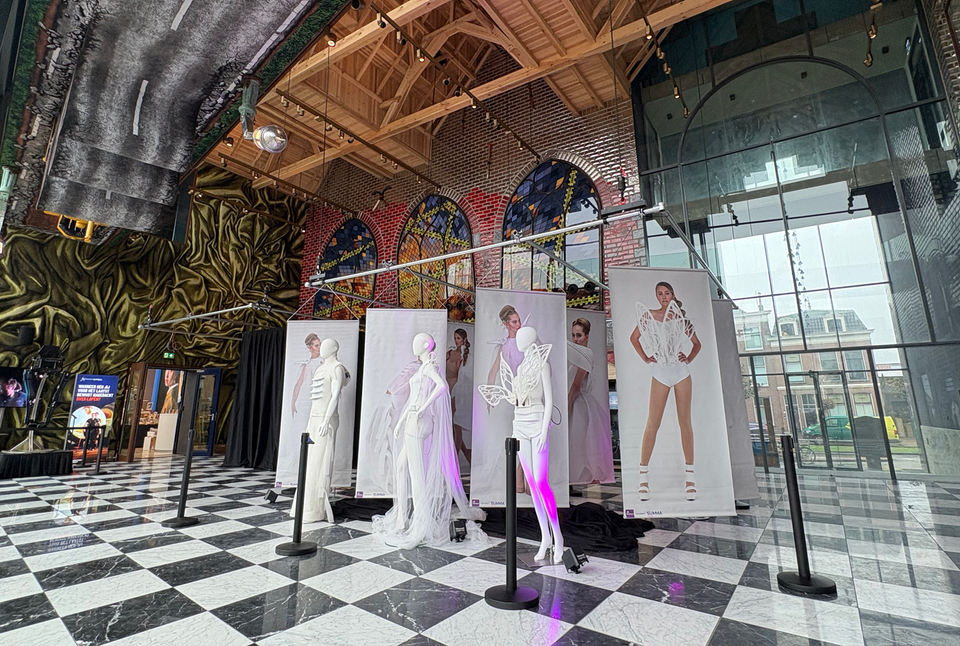
In ‘Like Insects’, fashion, nature and technology come together. Seven unique fashion-tech designs were developed by students from Summa Fashion and Fontys School of Engineering, under the guidance of international fashion-tech designer Anouk Wipprecht.
Inspired by the world of insects, the designs combine fashion with, amongst other things, electronics, mechanical movement, sensor technology and 3D-printed components. In this way, clothing becomes more than just a form for the body: technology becomes part of the design and can respond to people and the environment.
Like Insects forms the centrepiece of a temporary exhibition in the Innovation Gallery on technology capable of sensing and responding. Applications from Project MARCH, Tover and Simendo also demonstrate how sensor technology is used to help people move, play, learn and train.
From fashion to healthcare and from robotics to medical technology: the same fundamental question keeps cropping up.
How does technology actually know what we’re doing?
Come and see, discover and experience how design and technology are becoming increasingly accessible to people.
Robotics in the Innovation Gallery
The opening exhibition of the Innovation Gallery shows how robotics and its knowledge is evolving. The impact of robotics is huge; it contributes to solving problems such as ageing, climate change and a tight labour market. Robots can help with heavy, dirty or dangerous work and offer new opportunities for transport, manufacturing and inspections. Robots are also used for research, education and art making. They are not always visible but are of great value.
The exhibition shows how Innovation Gallery partners are using robotics in their fields of work. Such as the DaVinci operating robot from Reinier de Graaf Gasthuis, which ensures more accuracy and serves as a solution for the growing demand for care. Or, for example, TNO's Telepresence Hand that allows you to feel in the Netherlands what a robot feels in Australia.
At the Innovation Gallery, see, experience and learn about the impact of robotics in our daily lives.
The robots are coming
MycoGravity
MycoGravity was developed by Amir Bestan, Noor Stenfert Kroese and Johannes Braumann at Creative Robotics at the Univeristy of Arts Linz. MycoGravity investigates what happens when living things develop without the influence of gravity. Many fungi use gravity as a natural guide to how and where they grow, although we still don't understand exactly how that process works.
MycoGravity invites us to think about how life might adapt beyond Earth, and how living systems react when their familiar rules disappear.
Discover and experience MycoGravity in the Innovation Gallery at Huis van Delft.

Sneak peak - Discover the entire exhibition in the Innovation Gallery
-
AUTONOME DRONE

TU Delft won first place at the A2RL Drone Championship in Abu Dhabi, 2025. The challenge: make an autonomous drone with more than one camera cover a course as fast as possible, racing against other teams from around the world.
-
THE DELTARES GEOCENTRIFUGE

Knowledge institute Deltares does applied research on water, soil and infrastructure. Using small scale models, they investigate in Delft how a dike, road or wind turbine can withstand the forces of nature.
-
OPERATING BOOT

Reinier de Graaf is the oldest hospital in the Netherlands and has been providing care to the residents of Delft and the surrounding area for almost eight centuries. At the same time, they look to the future and use innovation to make tomorrow's care possible.
-
THE FUTURE OF TELEPRESENCE ROBOTICS

TNO is investigating how people can work intuitively with robotics remotely. Using a sensor glove that registers hand and finger movements, a robotic hand can be controlled naturally.
-
BIOTECH PRODUCTS

Automation and robotics are an essential part of R&D work at dsm-firmenich - including here in Delft. In the development of biotechnological products, robots are used in strain construction, fermentation, production, purification and analysis.
-
THE FUTURE OF TRADITION

Pottery has been hand-painted and transformed into Delft Blue Ceramics at Royal Delft since 1653 - a craft that requires precision and knowledge of the material. How well can a robot imitate the art of Delft Blue?
-
VISLIFT

Innovation is essential for the Delfland Water Board to be prepared for changes, such as increasing pressure on space, climate change, the transition to a circular economy and the growth of digitalisation. In doing so, Delfland deploys several innovative methods, such as the fish lift.
Artist Job Smeets tells more
At the Innovation Gallery, Delft showcases its future, where curiosity and discovery take centre stage. Delft innovations such as robots, medical devices and pioneering inventions from TU Delft are exhibited and interwoven with historical elements such as the Nieuwe Kerk and Johannes Vermeer. Artist Job Smeets thus creates a lively, playful context reminiscent of a market square. Where people used to display goods, the technological future is now on display.
Explore more stories
